Here’s something I wish more people knew about CBD.
Your skin already speaks cannabinoid.
Seriously.
Long before CBD oils, gummies and skincare products were everywhere, your body was already making its own cannabinoids.
They're called endocannabinoids.
And your skin has an entire system that responds to them.
It’s called the endocannabinoid system, or ECS, and once I really started understanding how it works in the skin, CBD skincare made a whole lot more sense to me.
Because CBD isn't interesting for eczema just because it became popular.
Researchers are studying cannabinoids and inflammatory skin conditions because there was already a biological reason to look.
And that's where this gets really interesting.
Your Skin Has Its Own Endocannabinoid System
Most people have heard of the nervous system or immune system.
But the endocannabinoid system?
Not so much.
The ECS is a signaling system found throughout the body. Our bodies naturally produce molecules called endocannabinoids, including anandamide and 2-AG.
And yes, this system is active in the skin.
Researchers have found cannabinoid receptors and other parts of the ECS in sebaceous glands, hair follicles, immune cells and other structures within the skin.
Even more interesting, research suggests this system plays a role in maintaining skin homeostasis, barrier formation, immune activity and itch signaling.
In plain English?
Your skin has its own balancing system.
And cannabinoid signaling is part of it.

THE PART I FIND FASCINATING:
We didn't discover cannabinoids and then teach our bodies what to do with them. Our bodies were already producing their own cannabinoids and using cannabinoid-responsive pathways long before we knew the system existed.
So What Does This Have to Do With Eczema?
Quite a bit.
Eczema, also called atopic dermatitis, involves a combination of skin-barrier dysfunction, inflammation and immune-system activity.
And then there's the itch.
Anyone who has eczema, or has watched their child go through a bad flare, knows how big that part is.
Skin gets irritated.
It itches.
You scratch.
Scratching damages the barrier even more.
Which can create more irritation and more itching.
Around and around you go.
Researchers have become interested in the ECS because it appears to play a role in several things happening here, including inflammation and itching.
And studies suggest that this system may not work the same way in skin affected by eczema.
That doesn't mean CBD magically fixes eczema.
It means there's a real biological reason scientists are studying it.
Big difference.
Does Topical CBD Help Eczema?
This is where I'm going to give you the answer I would want someone to give me.
The research is promising.
There have been human studies of topical cannabinoids in dermatitis and other inflammatory skin conditions, and most have reported improvements in itching, dryness and other symptoms. But many of these studies are small, use different cannabinoid compounds or formulations, or don't isolate CBD by itself.
And that's important.
Because a study of a cannabinoid-containing cream isn't automatically proof that CBD alone produced every result.
More recently, researchers pulled the available evidence together.
A 2025 systematic review and meta-analysis looked at cannabinoid research involving more than 3,300 people with different skin conditions.
The interesting part?
Researchers found a modest but significant improvement in itching.
Other measures, including overall eczema severity, dryness and skin barrier function, didn't show the same clear improvement.
In other words, the strongest signal so far seems to be around itch, which is pretty interesting when you consider how much itching drives the eczema cycle.
We still need larger, better-designed studies that follow people for longer periods of time.
I actually like that result.
Because that's how science works.
It doesn't say:
CBD CURES ECZEMA!
And it doesn't say:
CBD DOES NOTHING!
It says there's a signal, particularly around itch, worth continuing to investigate.
CBD for Skin Itching May Be One of the Most Interesting Areas
If you've dealt with eczema, you already understand why this matters.
Itch isn't some minor inconvenience.
It can be the thing that keeps you awake.
The thing that makes a child scratch until their skin is raw.
The thing that turns a little irritated patch into a much bigger problem.
And cannabinoid signaling appears to interact with several pathways involved in itch sensation, including cannabinoid receptors and other receptors found in skin and sensory nerves. Researchers are actively exploring whether these pathways can be targeted to help manage itching.
Again, we're not at “case closed.”
But we're definitely past “there's no science behind this.”
What About Inflammation?
Here's another reason researchers keep coming back to cannabinoids.
Your skin isn't just sitting there.
It's constantly responding to what's happening around it.
Heat. Cold. Irritation. Injury. Allergens.
Your skin cells and immune system are constantly communicating, basically deciding when to sound the alarm and when to calm things back down.
And guess what appears to be involved in some of that communication?
The endocannabinoid system.
Laboratory and animal research suggests cannabinoid signaling can influence some of the inflammatory processes happening in the skin.
And that's important because inflammation is a big part of what’s happening with eczema-prone skin.
CBD gets especially interesting because it doesn't work through just one simple pathway. It interacts with the endocannabinoid system and other pathways involved in how our skin responds to irritation and inflammation.
Translation:
It's complicated.
But honestly, our bodies usually are.
Why Topical CBD?
This is another distinction that gets lost constantly.
Putting CBD on your skin is not the same thing as swallowing CBD.
A topical salve is applied directly where you want it.
Topical CBD works primarily where it's applied, with little to none reaching the bloodstream, unlike ingestible CBD.
And for someone dealing with one angry patch of skin?
Local application makes intuitive sense.
You're putting the product where the problem is.
And here's something I've learned from using salve on itchy skin: you don't have to wait hours before applying it again.
During a flare, I pay attention to the itch. If the urge to scratch comes back, that's my cue to apply a little more.
Sometimes that might be pretty often.
The goal is simple: if you can calm the itch before the scratching starts, you're helping interrupt that itch-scratch cycle.
You don't have to wait until the skin is completely worked up again.

What About Topical CBD for Kids With Eczema?
This is where I become a mom before I become a business owner.
I have personally used CBD on my own children.
That's my family's decision.
I'm not going to tell another parent that they have to make the same one.
There has been some research on topical cannabinoids in children with eczema, and the early results are promising.
But we still don't have a lot of long-term research specifically on CBD and childhood eczema.
Researchers are still working out things like how much to use, how often to use it and what long-term use looks like.
And honestly? What we're seeing so far gives me a lot of reason to be excited about where this research is going.
So I think parents deserve information rather than fear or hype.
That's exactly why we created our CBD & Kids guide, where I go deeper into the questions parents ask me most.
And if CBD isn't something you're comfortable using on your child?
That's okay too.
We make Baby Balm without CBD or essential oils for exactly that reason.
Parents should have choices.

The CBD Isn't the Whole Formula
This is a big one for me.
I was working with medicinal herbs long before CBD became the ingredient everyone wanted to talk about.
And I've never believed one trendy ingredient should do all the work.
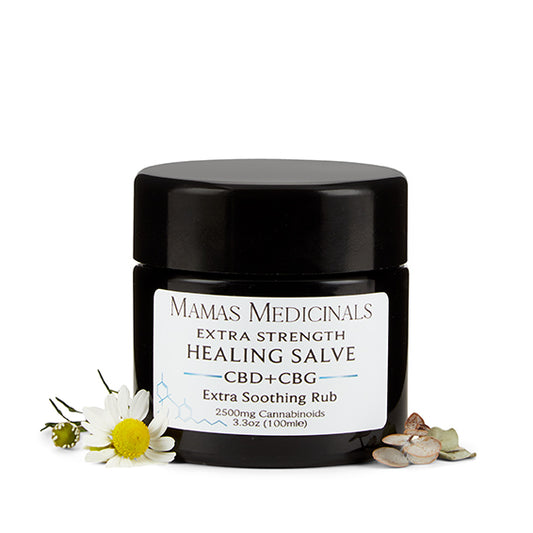
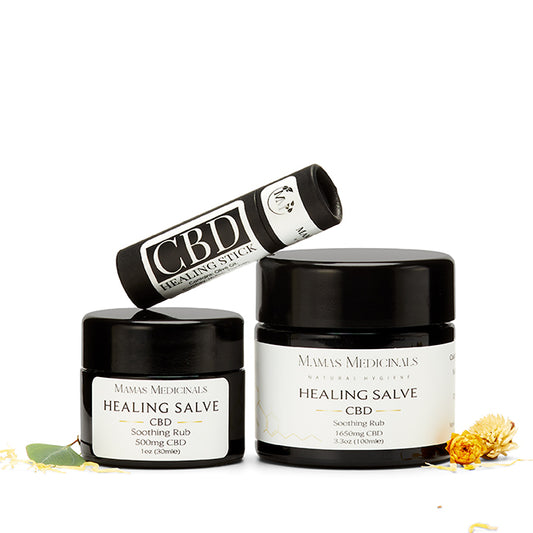
Our Healing Salve combines CBD with a blend of botanicals that we infuse slowly for six weeks.
Not six hours.
Not extracts dumped into a base cream.
Six weeks of cold infusion.
Many of the herbs we use are locally sourced and wild-harvested here in Northern California. We make the salve in small batches and package it in violet glass.
It's the slow way.
That's intentional.
Because when someone tells me, “CBD didn't work for me,” one of my first questions is:
What else was in the product?
CBD concentration matters.
The carrier matters.
The rest of the formula matters.
How it was made matters.
And the research itself reflects this problem: topical cannabinoid studies use very different formulations and delivery systems, making it difficult to treat every “CBD cream” as if it's the same thing.
They're not.
How I Use Healing Salve on Eczema-Prone Skin
I keep this ridiculously simple.
After bathing, gently pat the skin so it's still slightly damp.
Then apply some salve to the irritated area.
And pay attention to the skin.
If it starts getting dry or itchy again, that's when I reapply rather than waiting until the skin is completely worked up.
And sometimes that means applying it a dozen times throughout the day.
During a flare, I don't worry about how many times I've applied it. If the urge to itch comes back, that's my cue. For me, the goal is to get ahead of that itch and scratching cycle before the skin gets more worked up.
That's it.
No 12-step routine.
No bathroom counter covered in products.
When skin is reactive, sometimes doing less is exactly what the skin needs.
Patch test first, especially on sensitive skin.
CBD Isn't Magic. Biology Is More Interesting Than That.
This is probably my biggest takeaway after digging into the research.
I don't think CBD is interesting because it's trendy.
I think it's interesting because our bodies already have an endocannabinoid system.
Our skin produces endocannabinoids.
It contains cannabinoid receptors and cannabinoid-responsive pathways.
Those pathways are involved in processes researchers are trying to understand in eczema, including inflammation, barrier function and, particularly, itching.
And now researchers are asking:
Can plant cannabinoids interact with that system in ways that help troubled skin?
We don't have every answer yet.
But we have enough evidence to make the question worth asking.
And enough to keep studying.
For me, that's much more exciting than another miracle-skincare claim.
Ready to see how we make ours? Explore our slow-infused Healing Salve and the botanical ingredients behind it.